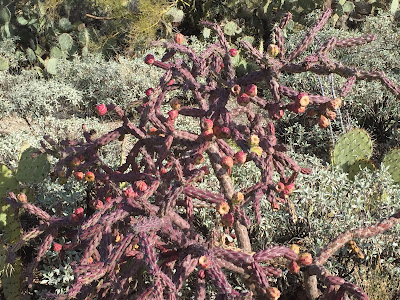
On the last day of my trip to Tucson, I was able to visit Saguaro National Park. Divided into two sections, separated by the city of Tucson, my aunts drove me to the larger eastern section of the park. The giant saguaro cactus is the state symbol of Arizona is known for it's white budding flowers that appear in spring. Saguaro cacti can grow very tall, upwards of forty feet. Having rained a lot the day before, the park was cool and very green. It was so great to see the natural diversity of the park and it was a great way to end my trip to Arizona. I had wonderful time seeing my aunts, friends Ann and Jack, and visiting Tucson. I hope to visit again in the future!
One of the many benefits of living in Oak Park, IL is that I'm lucky to live around many historical and fascinating landmarks. One particular place is the home and studio of architect and designer Frank Lloyd Wright. Constructed in the late 19th century, his home was his first building he worked on as an architect. He would make additions and rework rooms like a drawing, re-configuring spaces to accommodate himself, his wife and their six children (with only one bathroom). The house is run by the Frank Lloyd Wright Trust that oversees many other Wright buildings around Chicagoland. John and I were able to see the house on a day with free admission and freshly decorated for Christmas. Photos were not allowed inside, but of the photos I did get, you can sense the development of a distinctive architectural style that defined Wright.
I really liked painting in college and grew to love the process of finding different styles and materials to work into my pieces. Part of my process with paintings or any art I'm currently producing is based around the idea of 'fancy things', so this is a good time to remind myself and to articulate myself to anyone who reads this blog and for anyone looking to interpret what I make down the road. Fancy Things is my personal idiom, or expression, that encapsulates my interest in history (loosely interpenetrated), architecture, nature, my favorite color, which is sea foam (jadeite) green, and many other things.
In creating anything I usually feel like an archeologist who has to dig away at soil to unearth a discovery. With other artists, it sounds as though they are piling on soil onto a mound to wait and see if something is growing to become something amazing. I feel as though my 'digging' is articulating my world of splotchy, jagged, elegant objects, places, and people. It's a world of fashion-like poses, heroic and composed. However, I find the heroism of the people who sometimes end up in my work seem too perfect. They need jagged spots of paint and random touches of gold leaf to somehow prove the imperfections of their established disposition, possibly their hopes and ambitions, or maybe their imperfect virtues.
I was really interested in linear forms in college. I did hours and hours of sketching and have many sketch books to prove it. I would draw lines for very for a very long time and the more I drew the more I discovered that not all lines were created equally. When I started painting I did patches of different colors and sometimes would draw lines over and under the patches. I began incorporating fabric patterns into my work, sometimes used the colorful cartoons showing people in the articles meant to be created. I loved the transparency of the tissue paper-like material. I loved the predetermined lines upon the paper that seemed to guide the composition of the painting I was working on. I would use glaze to apply the pattern that involved painting under and over and all around.

These days I feel like I'm trying to uncover a world that is juxtaposed with being formal, balanced, and classical in a sense, to a world that is disjointed, asymmetrical, and sometimes alienated--this is represented with my usage of appropriated imagery that I rip out of outdated children's books. For me, I am not trying to copy the image, but reinterpret it. I'm fighting its original context and introducing it to a new language. I want it to be my fanciful world of light mossy green with clouds and veils of gold that reflect light and thoughts. Francois Boucher is my inspiration to capture the quiet subtle love between new lovers hidden within a walled garden, surrounded by lush greenery and trees that exude innocent, but passionate romance. Yet, within that garden, there are dark undertones that are lurking that imply forces of danger or impediments that could disturb the innocence of the scene.
With my new work I hope to keep expressing my world of aged illustrations, flat mossy green, imperfect lines, jagged texture, along with some highlights of gold.
The final point I'd like to make is that with the way I paint is not about the 'process' or how long it takes me to produce a painting. It's about the idea and whether or not what I'm making achieves my expression in the correct way. I ask myself if I'm expressing the correct idea through what I make? Am I exploring my materials correctly and to their full potential? Fancy Things allows me to return to aesthetic and intellectual passions and interests that continue to inspire me. And ultimately, the questions help direct me to express a world that happens to be fancy.
Stephen Greenblatt's The Swerve: How the World Became Modern is a wonderful understanding of the development of Western culture and philosophy. Greenblatt scours ancient and Medieval history to present the discovery of a poem, written thousands of years ago by Lucretius, and the Italian Renaissance man, Poggio Bracciolini, who planted the seed of discourse that would uproot the religious establishment in Europe.
Below is a key passage, that I find personally inspiring and enlightening:
Understanding the nature of things generates deep wonder. The realization that the universe consists of atoms and void and nothing else, that the world was not made for us by a providential creator, that we are not the center of the universe, that our emotional lives are no more distinct than our physical lives from those of all other creatures, that our souls are as material and as mortal as our bodies-all these things are not the cause of despair. On the contrary, grasping the way things really are is the crucial step toward the possibility of happiness. Human insignificance-the fact that it is not all about us and our fate-is, Lucretius insisted, the good news.
It is possible for human beings to live happy lives, but not because they think that they are the center of the universe or because they fear gods or because they nobly sacrifice themselves for values that purport to transcend their mortal existence. Unappeasable desire and fear of death are the principal obstacles to human happiness, but the obstacles can be surmounted through the exercise of reason.
The exercise of reason is not available only to specialists; it is accessible to everyone. What is needed is to refuse the lies proffered by priests and other fantasymongers and to look squarely and calmly at the true nature of things. All speculation-all science, all mortality, all attempts to fashion a life worth living-must start and end with a comprehension of the invisible seeds of things: atoms and the void and nothing else.
It might seem at first that this comprehension would envitably bring with it a sense of cold emptiness, as if the universe had been robbed of its magic. But being liberated from harmful illusions is not the same as disillusionment. The origin of philosophy, it was often said in the ancient world, was wonder: surprise and bafflement led to a desire to know, and knowledge in turn laid the wonder to rest. But in Lucretius' account the process is something like the reverse: it is knowing the way things are that awakens the deepest wonder.